

How do customers, decision-makers, and buyers find your company? For the past 10 years, we’ve been able to rely on one answer: Google. Either through paid search results (SEA or Google Ads) or organic search results (SEO). However, there are currently a lot of changes happening in search behavior, and suddenly the answer doesn’t seem so clear-cut anymore—think SearchGPT.
Since AI search currently (still?) does not include paid results, tools like SearchGPT are particularly relevant for SEO and raise two important questions: Will SearchGPT replace SEO in the future? And how can your company maintain visibility and generate leads if link lists are replaced by AI-generated text?
“Google will do the Googling for you”
– Liz Reid, Head of Search at Google
What is SearchGPT, and why is it important for your business?
GPT Search is OpenAI’s AI-powered search engine, which accesses data from the web in real time—not just training data. Unlike a traditional Google search, however, it doesn’t return a list of links, but rather a contextual, conversational-style response.
However, ChatGPT isn’t the only tool with an AI search feature (when web browsing is enabled). GPT Search is also available on other platforms, such as perplexity.ai or Microsoft Copilot.
Where does your company come into play? The websites where the information comes from are cited as sources and linked to, or quoted directly. So if your content provides a “good” answer to the question being asked, you’ll remain visible even without a number-one ranking.
What's What: SearchGPT vs. ChatGPT, Search vs. Google, and AI Overviews
As we delve deeper into GPT Search and SEO, it’s important to take a moment to assess the various tools and channels—after all, OpenAI’s SearchGPT isn’t the only one shaking up the market right now. Here’s an overview of the different players:
|
|
SearchGPT & Co
|
ChatGPT
|
Google
|
AI Overviews
|
|---|---|---|---|---|
|
Purpose
|
AI-powered search engine for : direct answers |
AI chatbot for answering questions , generating text, posts, emails, etc. |
, an algorithm-based search engine |
: A Brief Summary of Various Topics |
|
Answer
|
Written response to , including references |
Flexible depending on the prompt; for longer texts, including some references |
List of relevant links, , ranked according to the algorithm |
Written response , including references |
|
Context
|
The context of the question is taken into account; follow-up questions are possible ( ) |
It resembles a normal " " conversation with someone |
Context from previous searches ( ) is not taken into account |
Context from previous searches ( ) is not taken into account |
|
Timeliness
|
Real-time information; is up-to-date but still less accurate than Google |
Training data & real-time data: via web search; is not always up to date |
Highly accurate real-time information |
Uses data from the web; still has some catching up to do in terms of timeliness |
|
Transparency
|
Citations in the form of links
|
Source citations are available only in the " " web search mode |
High transparency and " " since only links are displayed |
Links as sources, Verification is uncertain |
|
User
|
Personalized results for tailored to each specific user in context |
Personalized results for tailored to each specific user in context |
Personalized results, but tailored to the "average" user based on an algorithm |
Personalized results, but tailored to the "average" user based on an algorithm |
|
Integrations
|
Getting better and better at providing -specific information (e.g., flight details, etc.) |
No access to live data regarding specific information (e.g., flight information, etc.) |
Numerous integrations with and other websites and portals, with very detailed information |
It also provides specific information, such as prices, at , , but not always |
What do the numbers say about SearchGPT and its impact on SEO?
One thing is clear: existing SEO traffic isn't lost, but it is shifting. A recent study by Semrush provides insights:
- The shift away from organic search toward AI has already begun, but SearchGPT and similar tools will likely not surpass Google’s SEO traffic for another two to four years.
Here’s what that means for you: Although organic traffic will initially decline and traffic via GPT Search will grow, SEO remains relevant! In the coming years, users will continue to use both search options.
- ChatGPT Search frequently cites sources whose SEO ranking is below 21st place.
What this means for you: A strong organic SEO ranking is also reflected in SearchGPT, but (!) you also have a good chance of being cited as a source even if your content doesn’t currently rank on page one. In plain language: Even if your keywords are already dominated by competitors, you still have a good chance of successfully breaking into the market.
- In addition, the conversion rate for a SearchGPT visitor is 4.4 times higher than that of a "regular" SEO visitor.
Here’s what that means for you: A lead you generate through SearchGPT is “more valuable” than a “normal” SEO lead. So, in this case, less traffic via AI can actually have a greater impact than a traditional search engine visitor.
From SEO to GEO: 8 Content Marketing Strategies That Work
So let’s get to the most important question: What should B2B companies keep in mind when developing their content and SEO strategies to remain visible in SearchGPT and generate leads?
Our team provides strategic and operational support to more than 45 companies in the field of B2B online marketing. As you know, content marketing in the B2B sector has always followed different rules than in the B2C business—your target audience is narrowly defined, most products are complex and require explanation, relevant search terms are searched for less frequently, and quality is crucial for building trust.
As search behavior shifts toward SearchGPT, SEO faces new challenges—and opportunities (!). We have developed specific strategies that have already proven effective* for our clients.
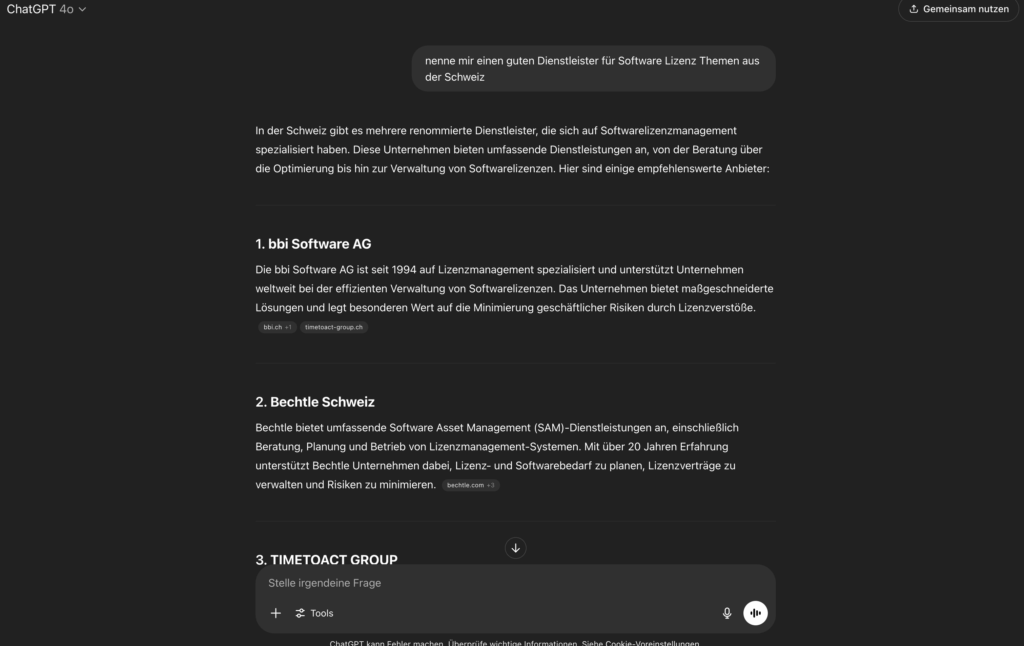
*Important: The search results in SearchGPT are not reproducible because the answers are constantly recalculated based on statistical principles, the content is dynamically evaluated, and the results are organized differently depending on the context.
1. GEO instead of “just” traditional search engine optimization
With the rise of AI platforms, a new buzzword has emerged in online marketing: Generative Engine Optimization (GEO)—that is, the optimization of content for generative search engines such as SearchGPT.
In practical terms, GEO represents an evolution of search engine optimization—moving from link lists (Google’s familiar results page) toward contextual search results (semantic, conversational-style text) in SearchGPT and similar platforms. This does not render B2B SEO strategies obsolete, but it does shift the focus even more toward quality rather than quantity—more on this in the strategies that follow.
Above all, it’s important that we no longer focus solely on Google, but also on generative search channels. This doesn’t mean optimizing all content exclusively for a single AI platform. Even though ChatGPT is currently the market leader, no one can predict today how the competition will evolve in five years. Our recommendation, therefore, is to incorporate GPT search tools into SEO and GEO.
2. "Traditional" SEO remains relevant for the time being
Building on the previous point, however, it is also important to emphasize that SearchGPT does not replace SEO. Here are two key points to consider:
- While SearchGPT is gaining traction, it will likely take two to four years before it surpasses traditional Google searches (see the Semrush study). The best practice, therefore, is to create your content not just for AI, but for SearchGPT, search engines, and (very importantly!) users.
- Many of the B2B SEO strategies we’re currently implementing remain highly relevant for SearchGPT as well! High-quality, up-to-date content isn’t just generally important for B2B prospects—it’s also been our top priority ever since Google’s E-E-A-T update two years ago.
Taking a two-pronged approach and keeping an eye on both SearchGPT and SEO is currently the best strategy.
3. Demonstrate your expertise through high-quality content
As previously noted, optimizing for SearchGPT does not mean throwing proven SEO strategies out the window. Quite the contrary. Especially in the B2B sector, content …
- high-quality
- substantive
- relevant to the target audience
- as up-to-date as possible
- practical
… should be. The goal is to establish yourself as an expert in your field. Since the E-E-A-T update mentioned earlier, Google has become better at recognizing content authority. SearchGPT and similar tools, on the other hand, which can also understand context, are essentially experts at identifying experts.
To ensure that you are cited or found via SearchGPT, clear branding as a specialist in your product or service is just as essential as it is for SEO. We achieve this by delving deeply into our clients’ complex solutions and working closely with product managers to incorporate not only factually accurate but, above all, unique and practical perspectives into the content.
4. Keywords vs. SearchGPT Prompts & User Intent
Another key factor to consider is: What question are you actually trying to answer? In traditional SEO, keyword analysis—taking into account search volume, search intent, and competition—is crucial. While this approach continues to provide valuable guidance, you should add another dimension when it comes to SearchGPT.
This is because searches in AI models are less keyword-driven and more semantically based. In other words, instead of searching for “best QM software” (a traditional keyword), users might search for something like “Which QM software will be the best for medium-sized companies in 2025? I need a solution with features for process management, document management, and audits” (semantic).
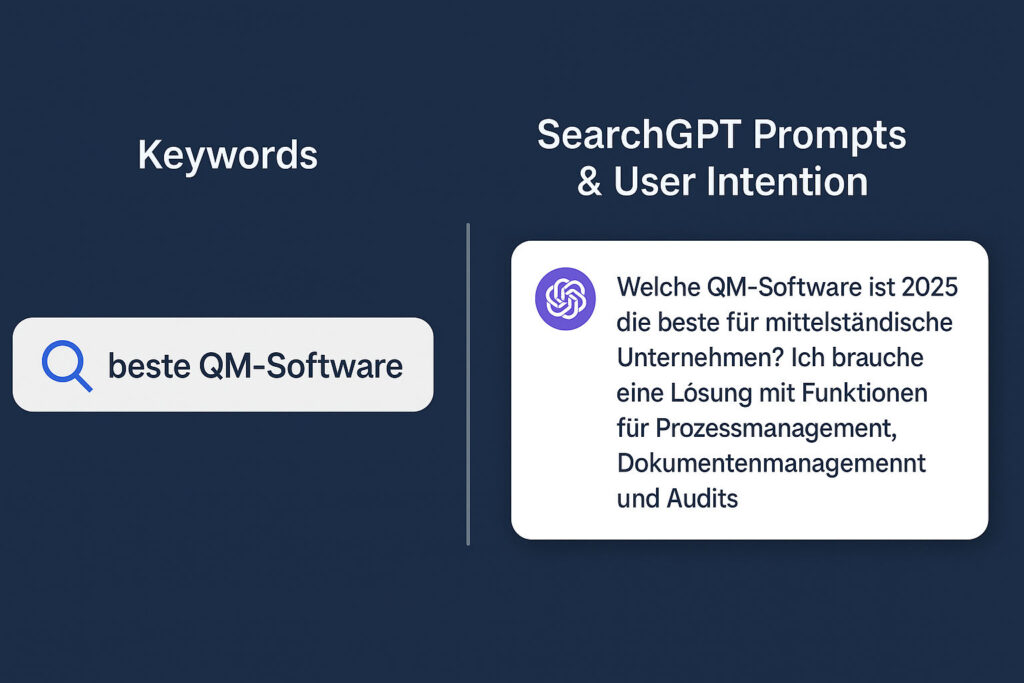
The challenge is: Semantic queries are not (yet) quantifiable. This is partly because every prompt is highly individual; after all, every user formulates their query differently. Additionally, there is not (yet) a tool that measures these queries in a manner similar to keyword tools (such as Ahrefs or Sistrix).
The solution is: We continue to focus on traditional keywords—because, as mentioned, SEO remains relevant—and supplement them with an even deeper understanding of your target audience and the topics that matter to them. When we identify the questions your customers are asking—e.g., using tools like Answer the Public or in collaboration with your sales team—and provide clear answers, this not only delivers SEO benefits but also increases your chances of being cited as a source by SearchGPT.
5. Don’t neglect technical SEO
Another aspect of “traditional” SEO remains important for SearchGPT as well—the technical foundation of your website. The reason is that, just like Google’s crawlers, AI search engines also scan the web for information that they can only find if the right technical conditions are in place. This essentially includes the same factors that are important to Google’s algorithms:
- Fast loading times (improved usability and all important information is loaded when the page is scanned)
- Mobile optimization (including usability; Google follows a "mobile-first" approach, and it is also easier for AI to process)
- Use schema markup (structured data can be read and interpreted more easily by crawlers and AI)
- User-friendly navigation (this also comes down to structure, and for SEO, it indirectly affects bounce rate and other metrics)
- Crawlability (just as you can set a page to "noindex," you can also block it from AI bots; however, your content will then not be found; the same applies to paywalls or content behind contact forms)
- Structured text (a clear hierarchy of headings also ensures greater structure and easier comprehension)
For us, it is now standard practice to review these technical aspects at the start of any SEO collaboration and to provide clear recommendations—or, if you prefer, to assist you with the implementation. To ensure that content is published correctly from a technical standpoint, we also rely on style guides and check the formatting of the text; alternatively, we can handle the formatting ourselves if you prefer.
6. Clear structures & modular content organization
For the next strategy, content meets technical SEO, because the more structured your content is, the better Google and SearchGPT can process it. In plain language, this means:
- Content should follow a clear thread and be structured in a coherent manner
- Individual sections should cover specific topics, and the content should be organized in a modular structure
- The key questions for each section should be answered clearly
- Content must not be redundant and should not contradict itself
- The structure should be reflected in a clear heading hierarchy
- Paragraphs should be short and organized in a way that reflects their content
So, even in this regard, traditional SEO strategies continue to prove their worth when implemented consistently.
7. Strategically expand content formats
The classic approach in content marketing—even for most of our clients—is an SEO blog. This remains relevant and is still an important source of information for SearchGPT. However, to further boost your visibility, it’s also becoming increasingly important to diversify your content formats. Here’s an example of what that might look like:
- Design lead magnets such as white papers; it is important that these offer readers significant added value that goes beyond simple blog posts
- Create video content that you can incorporate across various channels (e.g., on YouTube, in blog posts, or on social media)
- Publish your own studies, surveys, or publications on topics relevant to the industry
Even though we’ve been recommending more diverse content formats for years, this advice is becoming even more important due to SearchGPT and shifts in SEO behavior.
8. Domain Authority remains important, and link building is important again
Last but not least—while it’s currently not possible to assess exactly how SearchGPT evaluates a page’s relevance as precisely as with Google’s algorithm, your website’s domain authority still appears to be an important factor. Three criteria are key here:
- Site structure (a must-have, as described in the previous strategies)
- Relevance of the content (also an absolute must, as already mentioned)
- High-quality backlinks (aka link building)
A few years ago, building backlinks was still one of the most important SEO tactics; it was then given less weight in Google’s algorithm, but according to current estimates, it is once again gaining importance thanks to SearchGPT.
To put it in context: Domain Authority is generally considered one of the key criteria for achieving a Page 1 ranking on Google. It remains relevant for SearchGPT, but (!) as the Semrush study shows, the chances of lower-ranking pages becoming visible are also increasing.
Our conclusion: You should by no means neglect domain authority, but it’s not the only decisive factor. In-depth, high-quality, well-structured, and practical content is still more important.
Our assessment: SearchGPT will revolutionize SEO and offer unprecedented opportunities for B2B
Will SearchGPT replace SEO? Not for now. How can your business stay visible anyway? By understanding shifts in search behavior and content requirements, and by consistently implementing B2B SEO best practices with an additional focus on AI search engines. And: It’s important to act now!
We have never focused on creating content solely for search engines. Nor does it make sense now to create content solely for AI. The focus should always be on your customers—while taking into account the criteria that search engines and AI apply to content.
And we can already see that customers with strong SEO results and high-quality content from SearchGPT and similar platforms are appearing in search results more frequently. So the sooner you take action and adapt to the latest developments, the less you’ll be affected by the shift in search behavior—or you’ll be well-positioned for the future if you haven’t been actively pursuing SEO or GEO strategies yet.
Even though search behavior is changing and organic traffic will decline in the coming years, it isn’t “lost”—it’s simply shifting to other channels, such as SearchGPT. This presents an opportunity for many mid-sized B2B companies that don’t consistently rank on the first page to actually gain visibility and traffic gain.
As a B2B company with SEO expertise, our assessment is this: SearchGPT offers enormous potential, and you should act as quickly as possible to prepare for the revolution in the SEO sector that will take place in the coming years.
SearchGPT FAQ
What is SearchGPT?
SearchGPT is an AI search engine developed by OpenAI that accesses web data in real time and provides contextual answers. This technology is also available on platforms such as Perplexity.ai and Microsoft Copilot. Websites that offer high-quality content are cited as sources, ensuring visibility regardless of their Google ranking.
Will ChatGPT replace SEO?
ChatGPT and SearchGPT aren’t replacing SEO (for now), but they are shifting traffic as more and more users turn to AI platforms for information rather than Google Search. However, according to a study by Semrush , so SEO remains relevant, and companies should adapt to both search channels.
How can you rank in SearchGPT?
It is not possible to “rank” in SearchGPT in the same way as on Google. Instead, the focus is on visibility in sources, citations, or mentions in comparisons. Key factors here include high-quality, relevant content that the AI can use as a source, a well-structured website and content formats, and a technically sound website.
Should Google be worried about SearchGPT?
Google shouldn’t just be worried about SearchGPT—it most likely already is. After all, the impending revolution in search behavior calls Google’s business model into question, and the market giant feels compelled to catch up technologically—the best evidence of this is Gemini and AI Overviews. We’re curious to see how—and if—Google will effectively take on the competition.