

Contents
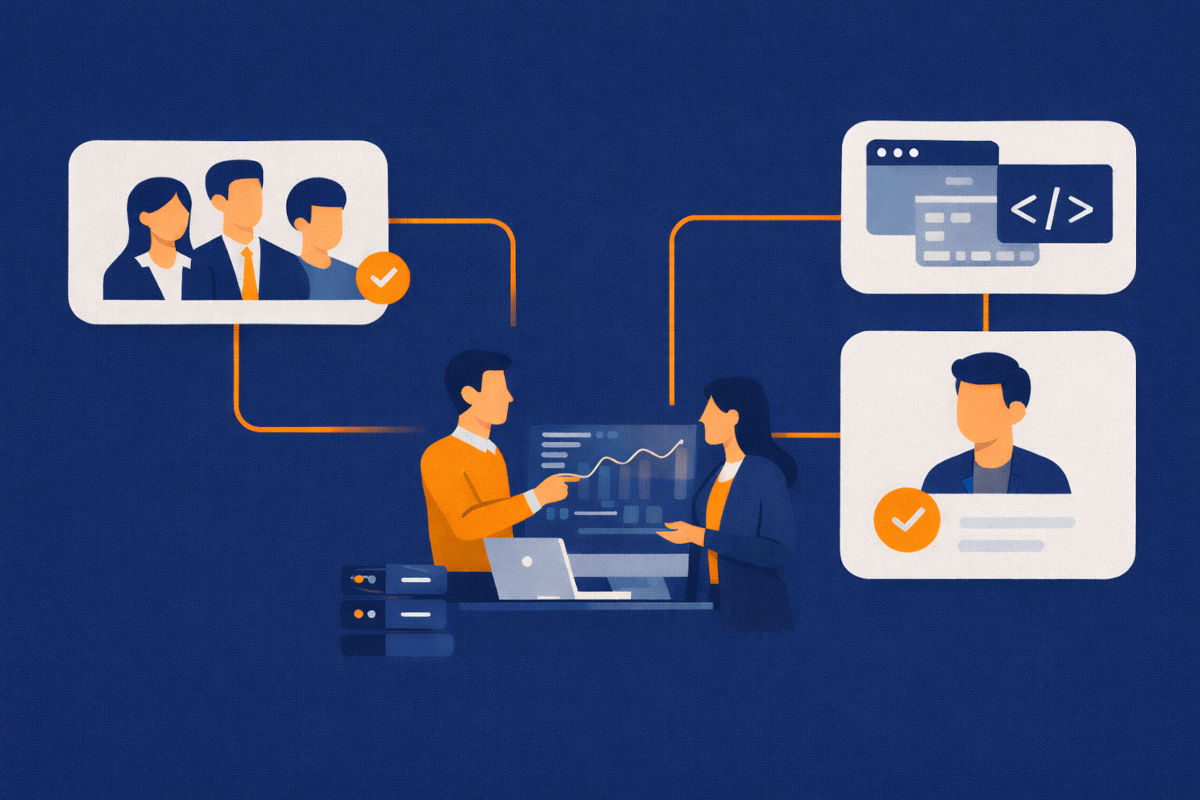
Complex products, long decision-making processes, and many stakeholders involved: IT B2B works differently than traditional marketing. The main difference is in the structure of decision-making roles: providers must simultaneously convince multiple roles with completely different information needs. In doing so, they must explain complex, intangible solutions in a way that is both technically accurate and commercially understandable. And because wrong decisions carry high risks—from integration problems to compliance issues—the buyer journey is significantly longer and more data-driven.
Many general B2B marketing approaches fall short here. We have been working exclusively with software and IT companies for years and know which factors really make a difference in B2B marketing in the IT industry: Successful lead generation is not achieved through individual channels or short-term tricks, but through a combination of strategy, target group understanding, communication, and clean implementation.
Our IT marketing tips show you which factors really matter in IT B2B.
The most important things at a glance:
- Understanding clear target groups and decision-maker roles: B2B marketing in the IT industry only works if technical advantages are precisely translated into business benefits and all stakeholders are specifically addressed.
- Structure instead of individual measures: An integrated marketing strategy with defined processes, test frameworks, and monitoring creates predictable lead generation and measurable ROI.
- Leverage IT-specific industry knowledge: Without an understanding of SaaS, system houses, integrators, and IT consultancies, measures will fall short. Specialized expertise ensures communication that really works in the market.
What is B2B IT marketing?
B2B IT marketing describes the marketing of complex IT and software solutions to various stakeholders. It combines technical understanding with clear, business-relevant communication and ensures that technical advantages are recognized as concrete business impact—across all channels of a strategic customer journey.
8 key success factors in B2B IT marketing
The following eight success factors show how IT and software companies can solve the challenges described above in practical terms. They form a structured framework for B2B marketing in the IT industry that is both technically precise and commercially relevant—and really makes an impact in buying committees.
1. Predictable lead generation as a building block for long-term stability
Political uncertainties and economic crises often have a significant impact on the dynamic IT sector. Decision-making processes are delayed, investments are postponed, and demand becomes more unpredictable.
This makes it all the more important to have a lead generation process that can be planned. Marketing should not be an end in itself, but should give you security—with clear processes and reliable results. This creates the stability you need to remain capable of acting even under difficult market conditions.
2. Sustainable IT marketing requires a strategy
Many IT companies lack a marketing strategy that delivers reliable results in the long term. Measures are launched, channels are tested, content is produced—but all without a common goal and without a clear framework. This leads to budgets being scattered and opportunities remaining untapped. Furthermore, there are no measurable results.
B2B marketing for IT service providers in particular requires a well-thought-out strategy. It determines who you want to reach, which messages are crucial, and how your channels should work together. Equally important are structured testing frameworks, regular monitoring, and continuous optimization across all channels used.
Only when everything meshes together and builds on each other can marketing be created that does not consist of individual measures, but rather enables reliable long-term growth.
3. Target the right channels and evaluate them accurately
In IT B2B marketing, a single channel is rarely sufficient. Measures are interlinked, and each touchpoint fulfills its own function—especially in customer journeys with more than 80 contact points. For this to work, companies must professionally support channels and optimize them regularly.
This is precisely where it often becomes difficult in-house: each channel requires its own expertise. Even with several freelancers, a great deal of coordination is required. At the same time, it is not reach or the cheapest click that counts, but the quality of the contacts you reach.
We often see marketing efforts stall because there is a lack of suitable employees. A reliable partner can ensure that channels are used, evaluated, and optimized reliably and over the long term.
This is precisely where Leadeffect comes in: as a specialized B2B marketing agency, we work exclusively with IT and software companies and understand the differences between SaaS, system houses, integrators, and IT consultancies in detail. This specialization enables us to translate technical advantages into business benefits, target specific decision-makers, and implement measures that really work. We take care of strategy and operational implementation—so your marketing runs smoothly without straining internal resources.
4. Correctly define your target audience and product-market fit
Effective communication only happens when the target audience and the solution are clearly aligned. Precise product-market fit is crucial, especially for B2B marketing in the IT industry, where products are complex and decision-makers play a variety of roles. Without a clear focus, your messages can quickly seem interchangeable or too technical—and fail to reach the people they are meant to convince.
To ensure that your positioning is effective, you should ask yourself the following questions, among others:
- Who exactly benefits most from our solution?
- What specific problem are we solving, and how urgent is it for the target group?
- Which roles determine or influence the purchase?
- How do the requirements of IT, management, and purchasing differ?
- Which arguments generate real benefits—both technically and commercially?
- How do we clearly differentiate ourselves from the competition?
5. Get your message and communication across clearly and concisely
"No one understands our solution" or "It's too complex to explain briefly" – phrases we often hear in B2B IT marketing. However, clear communication is crucial in determining whether interested parties immediately understand the benefits of your solution and whether attention translates into a qualified lead.
A clear message that makes technical advantages and business benefits tangible is key to this. An outside perspective can help here: in short, structured workshops, we work out what makes your solution special and how you can best reach your target group.
6. Continuously monitor trends and developments
The IT industry is changing faster than many other B2B sectors. New technologies, AI-supported solutions, and changes in search and information behavior directly influence how decisions are made. For effective B2B marketing in the IT industry, this means that providers must recognize and classify developments at an early stage.
It's difficult to cover everything in-house. With day-to-day business taking up so much time, there's often little opportunity to test new formats or properly evaluate trends. At the same time, if you react too late, you lose visibility. Keeping up to date with trends and their relevance ensures that your marketing doesn't stand still while the IT market moves on.
7. Estimate costs realistically and manage them in a targeted manner
In B2B marketing for IT services, the cost per lead is often higher than in other industries. This is mainly due to complex solutions, fierce competition, and long decision-making cycles. This makes it all the more important for you to use your budget efficiently and know exactly which measures really contribute to value creation.
This requires an approach that carefully examines the most important measures and makes the relevant KPIs transparent. Only when you understand which channels deliver results, where wastage occurs, and which measures generate actual ROI can you manage your marketing economically in the long term.
8. Avoid mistakes and save costly detours
Many mistakes in IT marketing are not caused by the wrong tools or channels, but by a lack of fundamentals: unclear target groups, inconsistent messages, or measures that do not fit together. However, one point that we hear repeatedly in conversations is different—and often the most costly: companies hire an agency that does not specialize in IT.
The IT industry encompasses a wide variety of business models. System houses, SaaS providers, integrators, and IT consultancies work with completely different sales cycles and decision-making structures. SaaS marketing, for example, requires specialized expertise that a SaaS marketing agency that has a deep understanding of this business model.
That's why it's crucial to work with experienced partners who understand these differences and can accurately assess the respective buyer journeys. This is the only way to precisely target audiences and develop messages that really work in the respective business model.
How a specialized partner can really advance your B2B IT marketing
In B2B IT marketing, complex solutions encounter long decision-making cycles, multiple stakeholders, and high demands on technical and business arguments. Without a clear structure, a patchwork of measures quickly emerges that do not fit together and fizzle out ineffectively in buying committees. Only a precise target group, a clearly communicated value proposition, and a coordinated channel framework can create marketing that scales reliably.
This is exactly where Leadeffect comes in: We work exclusively with IT and software companies and understand the differences between SaaS, system houses, integrators, and IT consultancies. We combine technical expertise with clear communication, develop messages that resonate in the market, and manage measurable measures throughout the entire funnel. The result is marketing that takes the pressure off your teams and delivers real results.
If you would like to know what this could look like for your company, simply contact us for a non-binding strategy discussion.
FAQs about B2B marketing in the IT industry
Why is B2B marketing important for IT companies?
B2B marketing helps IT companies make complex solutions understandable, build trust, and develop long-term customer relationships. It creates visibility in a highly competitive market and ensures that potential customers recognize the benefits of the solution and actively get in touch.
What is the difference between B2B IT marketing and "traditional" B2B marketing?
B2B marketing in the IT industry addresses complex solutions that require explanation and multiple stakeholders with different information needs. Technical advantages must be clearly translated into business benefits. As a result, decision-making processes are longer, more risk-driven, and more demanding than in traditional, less technology-centric B2B marketing.
How can I use IT marketing to generate qualified leads in the B2B sector?
Through clearly defined target groups and understandable, solution-oriented messages. Relevant content throughout the buyer journey builds trust. Continuous measurement and optimization ensure that measures are effective and waste coverage is reduced—this results in qualified leads with a higher probability of closing.
How do you develop a B2B IT marketing strategy?
A strategy for B2B marketing in the IT industry is created through a clear definition of the target group, a precise product-market fit, and messages that translate technical benefits into business impact. This is followed by appropriate measures along the buyer journey and measurable processes. Sound knowledge of the IT industry and continuous optimization are crucial.